27
02 2019
Recently, the research team led by Prof. YANG Chao from Qingdao Institute of Bioenergy and Bioprocess Technology (QIBEBT), Chinese Academy of Sciences (CAS), have systematically investigated the influences of orifice diameter, liquid viscosity, surface tension force, and orifice superficial gas velocity on bubble diameter of gas sparger under industrial jetting conditions. Gas-liquid and gas-liquid-solid reactors have been widely applied in fermentation, photosynthetic culture, metallurgy, and many other processes in chemical industries. Bubble size is one of the most important parameters for accurate design of gas-...
25
02 2019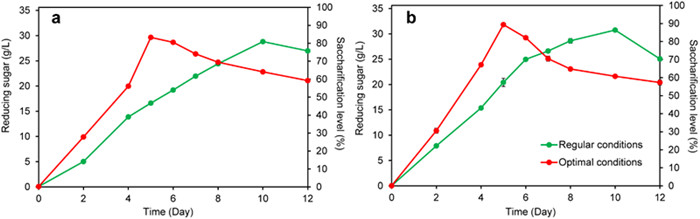
Recently, the Metabolomics Group from Qingdao Institute of Bioenergy and Bioprocess Technology (QIBEBT), Chinese Academy of Sciences (CAS) developed a novel strategy termed consolidated bio-saccharification (CBS) for cost-efficient lignocellulose conversion, which combines cellulase production and hydrolysis but separates fermentation from the integrated process and takes fermentable sugar as the target product to couple various downstream fermentation processes The industrial conversion of biomass to high-value biofuels and biochemical is mainly restricted by lignocellulose solubilization. Currently, three strategies are reported for lignocellulose bioconversion: separate enzymatic hydrolysis and fermen...
01
02 2019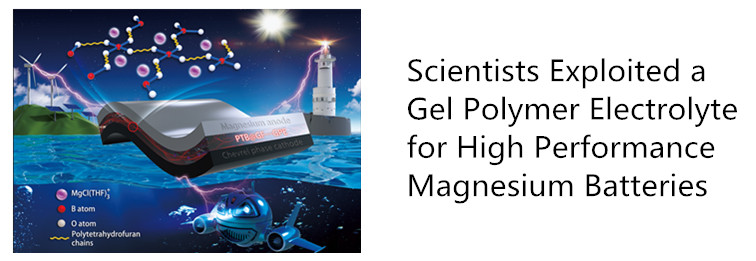
Recently,a research team led by Prof. CUI Guanglei from Qingdao Institute of Bioenergy and Bioprocess Technology (QIBEBT), Chinese Academy of Sciences (CAS), exploited a novel rigid-?exible coupling gel polymer electrolyte (PTB@GF-GPE) coupling with significantly improved comprehensive performance. It was synthesized via in situ crosslinking reaction of magnesium borohydride and hydroxyl-terminated polytetrahydrofuran.
Electronic products, electric vehicles and large-scale energy storage closely related to human life put up an ever-growing demand for rechargeable batteries.
Lithium-ion batteries, which are currently widely used, perform not well in terms of ...
28
01 2019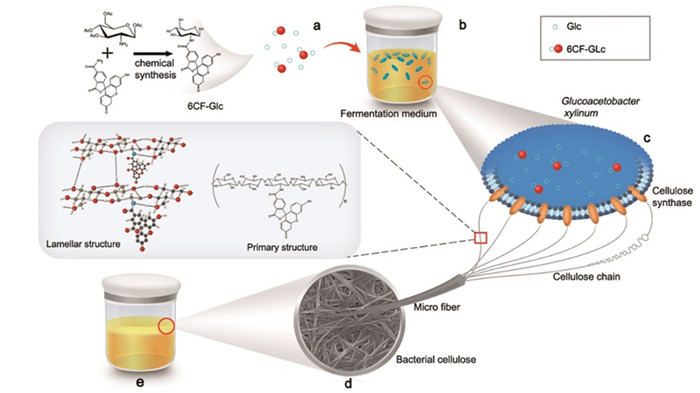
Recently, a research team, led by Prof. XIAN Mo and ZHANG Haibo from Qingdao Institute of Bioenergy and Bioprocess Technology (QIBEBT), Chinese Academy of Sciences (CAS), developed a new method for bacterial cellulose functionalization. Bacterial cellulose (BC) is a cellulose material produced by microbial fermentation with a unique porous network structure. Due to the high crystallinity, high specific surface area, high degree of polymerization, excellent permeability, high poro...
23
01 2019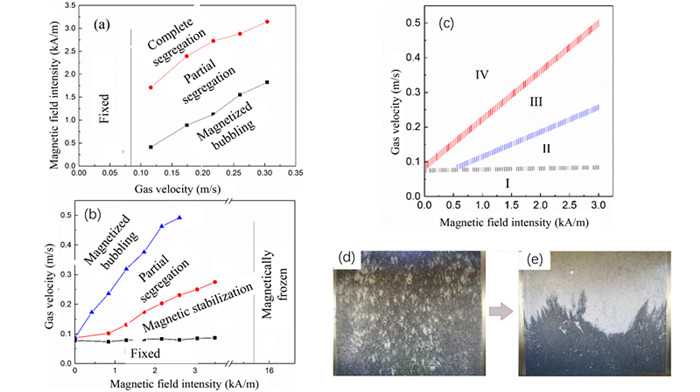
Recently, the research team led by Prof. HUANG Qingshan from Qingdao Institute of Bioenergy and Bioprocess Technology (QIBEBT), Chinese Academy of Sciences (CAS), has thoroughly investigated MFBR features and regime transitions.
The magnetized fluidized bed reactor (MFBR) is an integration of the bubbling fluidized bed reactor (BFBR) and the electromagnetic field. It is usually applied to deal with various gas-solid heterogeneous reactions.
The MFBR with the binary ad...
09
01 2019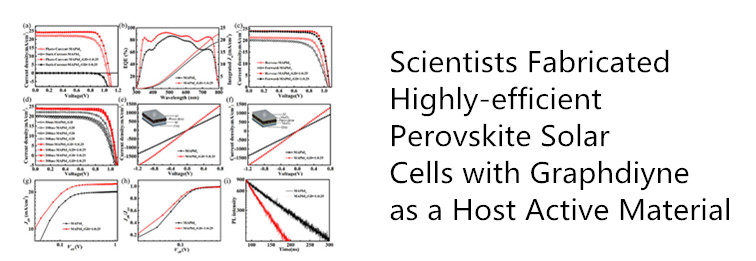
Carbon Based Energy Conversion Materials Research Team led by Professor JIU Tonggang from Qingdao Institute of Bioenergy and Bioprocess Technology (QIBEBT), Chinese Academy of Sciences (CAS), in collaboration with Academician LI Yuliang, first reported that the introduction of certain amount of GD (25%) as a host material in perovskite solar cells can successfully push the device efficiency up to 21.01%, achieving multiple collaborative effects of highly crystalline qualities, large domain sizes and few grain boundaries with neligible hysteresis as well as improved device stability.
As a new member of carbon materials following the presence of fullerene, carbon nanotubes and graphene, graphdiyne (GD) is firstly invented by Chinese scientists with independent intellectual property rights.
Meanwhile, progress has been made ...