Scientists propose integrated “synthesis-assembly-error correction” paradigm for high-fidelity long-fragment DNA synthesis
Scientists from the Qingdao Institute of Bioenergy and Bioprocess Technology (QIBEBT), Chinese Academy of Sciences, in collaboration with the Shenzhen Institutes of Advanced Technology (SIAT) and Zhonghe Gene Co., Ltd., have proposed an integrated “synthesis-assembly-error correction” paradigm that transforms fragmented DNA synthesis into continuous, automated, high-fidelity pipelines.
Published in Biotechnology Advances on May 31, the review argues that error control should be embedded throughout the entire process rather than treated as a final step.
DNA synthesis is foundational to synthetic biology and biomanufacturing. As research scales from single genes to metabolic pathways and genome-scale constructs, accurate long-fragment synthesis has become a critical bottleneck. Because current workflows isolate synthesis, assembly, and correction into discrete steps, automation platforms remain stuck at the individual-module level, preventing end-to-end integration.
The team argues that high-fidelity synthesis requires understanding the intrinsic coupling among synthesis, assembly, and correction—not simply stacking equipment. Error correction must be moved upstream and embedded into workflows as a determining factor for success.
Through comparative analysis, the authors identify MutS protein-mediated mismatch removal as particularly compatible with automation, positioning it as a critical quality-control module. Emerging enzymatic DNA synthesis offers additional advantages: mild aqueous conditions provide higher compatibility with downstream enzymatic assembly and MutS-based correction, enabling integration of all three stages.
Building on this, the authors propose an end-to-end workflow spanning enzymatic oligonucleotide synthesis, preliminary assembly, MutS mismatch removal, hierarchical assembly, and terminal quality control.
QIBEBT’s Single-Cell Center couples this with single-cell Raman phenotyping to close the loop, rapidly identifying top performers under label-free, non-destructive conditions and feeding results back to accelerate the “design-build-test-learn” (DBTL) cycle.
“The key to high-fidelity long-fragment DNA synthesis is not simply adding more correction steps at the end, but making error control an intrinsic property of the entire workflow,” said Assoc. Prof. ZHANG Jia from the Single-Cell Center at QIBEBT, corresponding author of the review, “Enzymatic synthesis may serve as the foundational platform transforming DNA synthesis from fragmented steps into a continuous, automated, real-time quality-controlled process, shifting from step-by-step detection to right-first-time, terminal verification”.
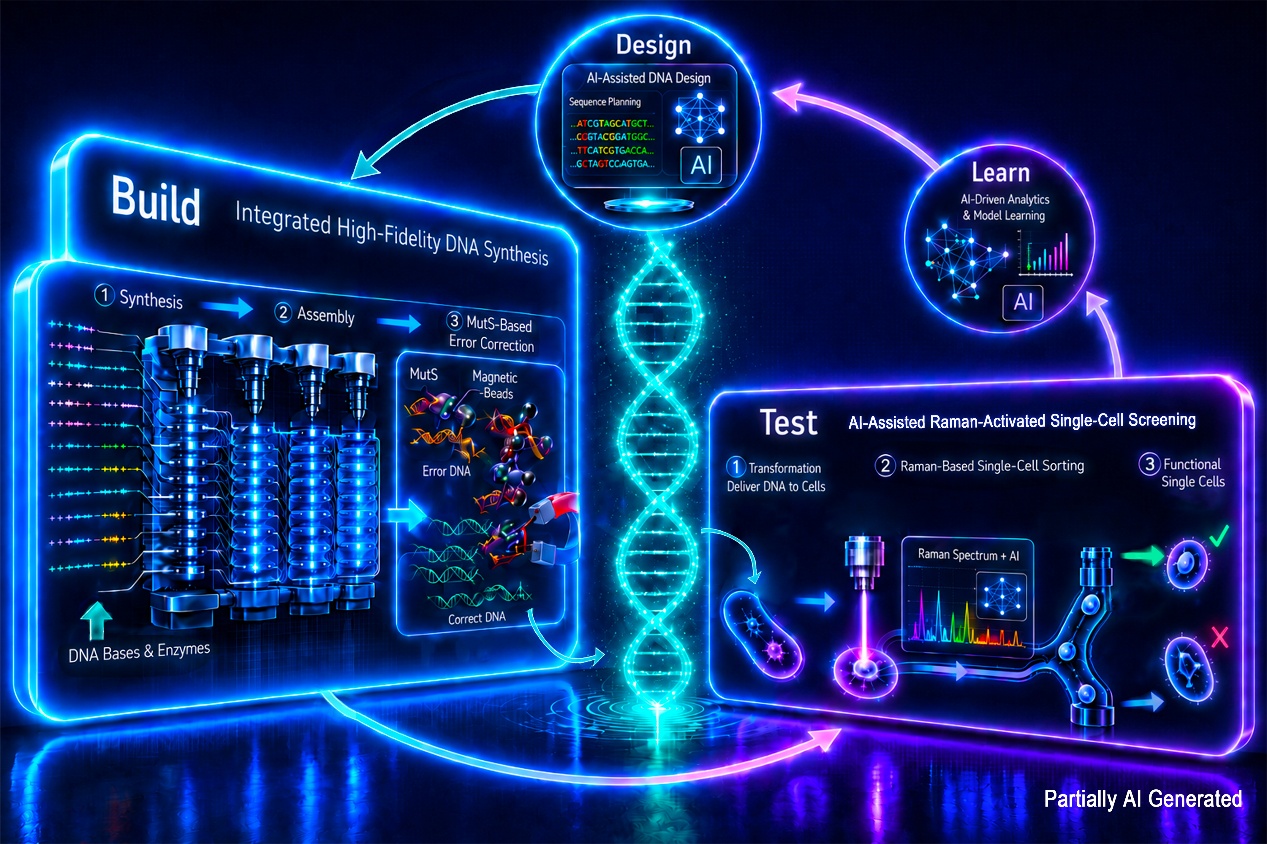
Schematic overview of the integrated “synthesis-assembly-error correction” paradigm for high-fidelity long-fragment DNA synthesis and its coupling with the DBTL cycle (Text/ZHANG Jia Image/LIU Yang)