Scientists Identify Molecular Switch That Coordinates Yeast Metabolism
Researchers from the Qingdao Institute of Bioenergy and Bioprocess Technology, Chinese Academy of Sciences (CAS), have identified a conserved ubiquitin-mediated regulatory mechanism that coordinates metabolic flux among multiple biosynthetic pathways in yeast. The study was published in Proceedings of the National Academy of Sciences.
Eukaryotic cells must allocate limited carbon resources across competing biosynthetic processes. Carotenoids, sterols, and lipids are tightly interconnected, as they share common metabolic precursors. However, the mechanisms by which cells dynamically balance these pathways have remained largely unresolved.
Using the astaxanthin-producing yeast Xanthophyllomyces dendrorhous, the researchers identified an E3 ubiquitin ligase, PTR1, as a central regulatory hub linking carotenoid, sterol, and lipid metabolism.
Further analysis revealed a PTR1-centered regulatory network that integrates these pathways. PTR1 modulates carotenoid biosynthesis through a reciprocal regulatory loop with the White Collar Complex (WCC), a key transcriptional regulator associated with carotenoid production. In addition, several PTR1-interacting proteins were identified, suggesting broader roles in fine-tuning sterol and lipid metabolism.
Importantly, PTR1 homologs are conserved across diverse eukaryotic lineages, indicating that ubiquitin-mediated regulation represents an evolutionarily conserved strategy for coordinating metabolic networks.
These findings provide new insights into ubiquitin-dependent control of metabolic flux in eukaryotic cells and expand the functional scope of E3 ubiquitin ligases beyond protein turnover to system-level metabolic regulation. More broadly, this work highlights ubiquitination as a promising regulatory layer for metabolic engineering, offering new avenues to optimize microbial cell factories for the production of astaxanthin, sterol, and lipid.
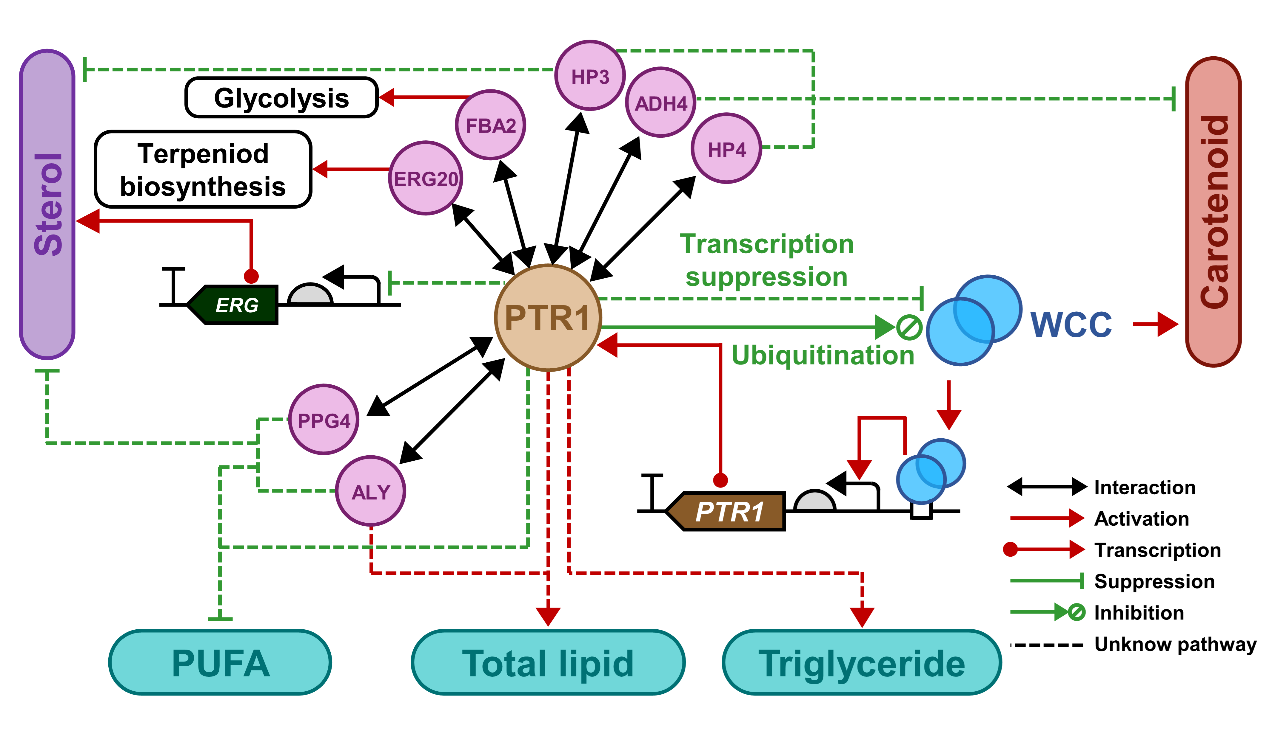
Fig. 1. Proposed model for PTR1-mediated regulation of carotenoid, sterol, and lipid metabolism.