Researchers Achieve Breakthrough Efficiency for CZTSSe Solar Cells Using Novel Strategy
Safe, efficient, and economical light-absorbing (photovoltaic) technology is key to developing the next generation of solar cells. Cu₂ZnSn(S,Se)₄ (CZTSSe) photovoltaics—using the easily accessible elements copper, zinc, tin, and sulfur and/or selenium—hold great promise thanks to their abundant elemental reserves, low cost, high stability, and non-toxic properties. Therefore, improving the efficiency of CZTSSe photovoltaic cells is an important focus of research.
A core technical challenge of this technology, however, is “uncontrollable metal ion migration” during the selenization phase transformation of CZTSSe.
To address this problem, a research team led by Prof. CUI Guanglei from the Qingdao Institute of Bioenergy and Bioprocess Technology (QIBEBT) of the Chinese Academy of Sciences has recently proposed a novel mechanism utilizing interfacial phase equilibrium to regulate metal ion migration. Specifically, the researchers developed a Li₂SnS₃ (LTS) interphase strategy to modify cation migration paths and balance Zn²⁺/Sn⁴⁺ migration differences.
The team’s findings were published recently in Nature Energy.
In this study, the LTS interphase selectively encapsulates Cu₂Sn(S,Se)₃ (CTSSe) intermediate grains, thereby becoming the rate-determining layer for ion migration. The difference in migration barriers between Zn²⁺ and Sn⁴⁺ is reduced from 0.41 eV in CTSSe to 0.21 eV in the LTS interphase. By slowing down reaction kinetics, the LTS interphase enables more controlled grain growth, thus promoting the formation of larger and more uniform grains. This significantly reduces deep-level defects and improves overall crystalline quality.
Using this approach, the team achieved a photovoltaic conversion efficiency—the measure of how much sunlight is turned into electrical energy—of 15.45%, with an internationally certified third-party efficiency of 15.04%. The researchers also noted that this is the first time open-circuit voltage has been raised above 600 mV at a bandgap of 1.10 eV. This represents an unusually high voltage for this material, showing that long-standing energy losses can be overcome.
This breakthrough has led to the creation of an intellectual property portfolio covering the entire LTS process, thereby providing theoretical and technical support for the industrialization of CZTSSe solar cells.
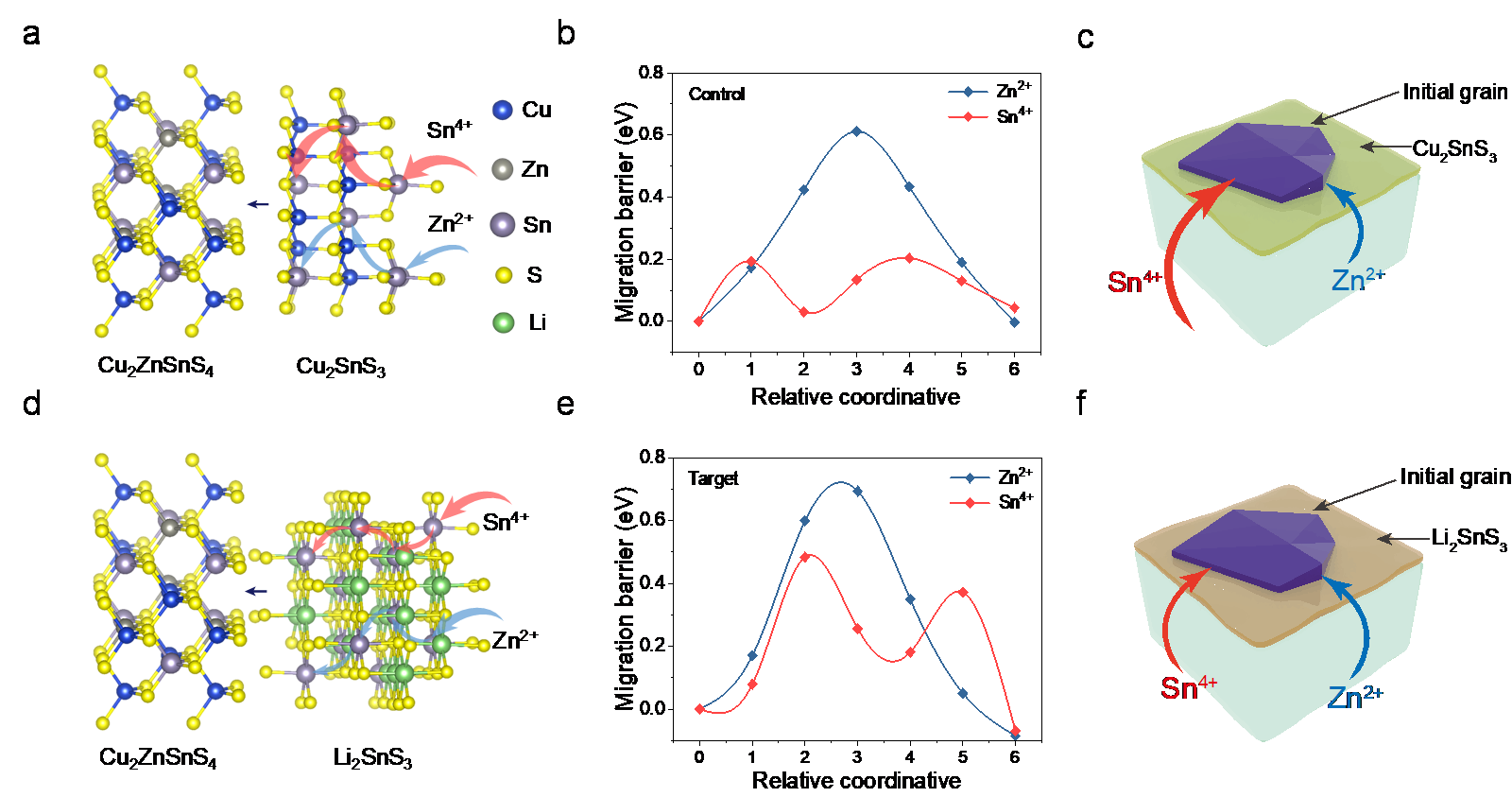
Schematic Diagram of Interfacial Phase Regulation for Metal Ion Migration in Li2SnS3