QIBEBT Co-hosts Advanced Training Course on iMAPS Initiative for Autotrophic Microbiome Mining
The Qingdao Institute of Bioenergy and Bioprocess Technology, Chinese Academy of Sciences (QIBEBT), together with Hainan University and the Autotrophic Microorganisms Committee of the Chinese Society for Microbiology, successfully concluded a training course on frontier technologies for mining autotrophic microbial resources on November 29, in Haikou, Hainan Province. The event, held alongside the first National Symposium on Autotrophic Microbiology, brought together more than 100 researchers and industry representatives from across China.
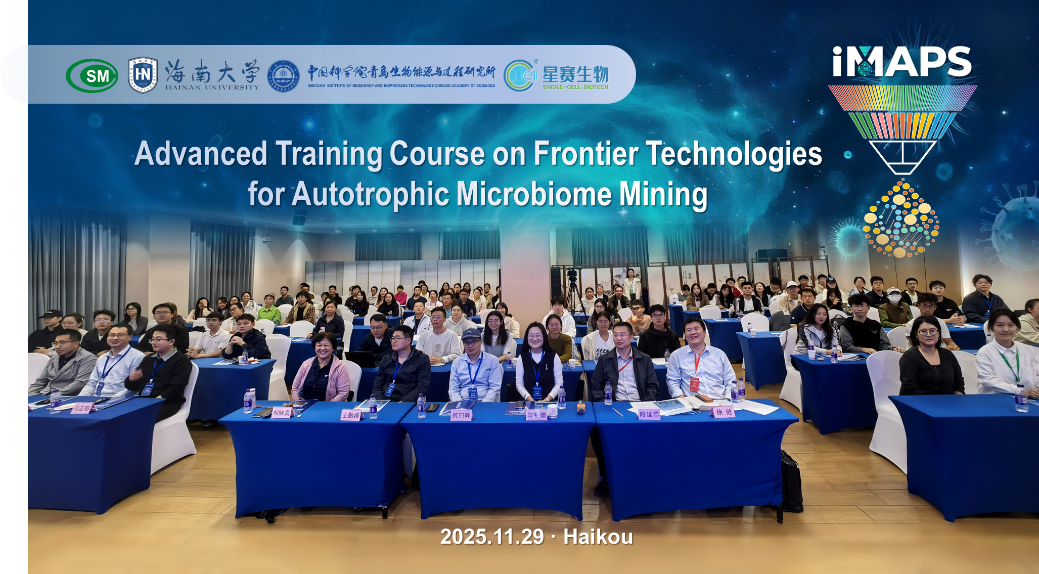
Autotrophic microbes, including key players in carbon cycling and biological nitrogen fixation, are essential to global biogeochemical processes and low-carbon biomanufacturing. However, their study and utilization have long been constrained by low-throughput isolation methods and limited access to in situ functional phenotypes. In his opening remarks, Prof. LU Yandu of Hainan University emphasized that technologies such as metaramanomics and single-cell metabolic phenotyping will be critical to overcoming these bottlenecks and accelerating discovery in the field.
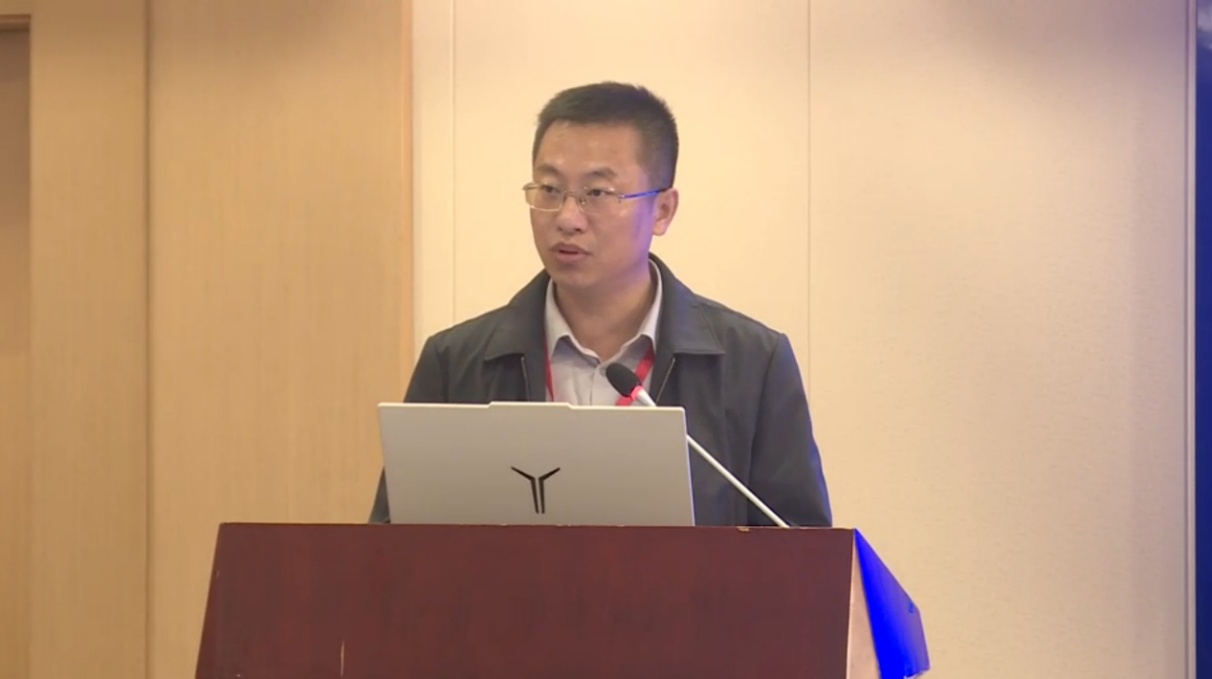
Prof. LU Yandu delivers remarks on behalf of the conference organizers.
During the half-day course, five experts from the Single-Cell Center at QIBEBT provided a systematic introduction to home-grown metaramanomics platforms and their applications. Senior engineer ZHENG Xiaoshan outlined the principles of metaramanomics and demonstrated high-throughput instruments including FlowRACS, a Flow Cytometric Raman-Activated Cell Sorter, and RACS-Seq, a Raman-activated Optical Tweezers-based Cell Sorter that can link phenotypes to downstream sequencing or cultivation.
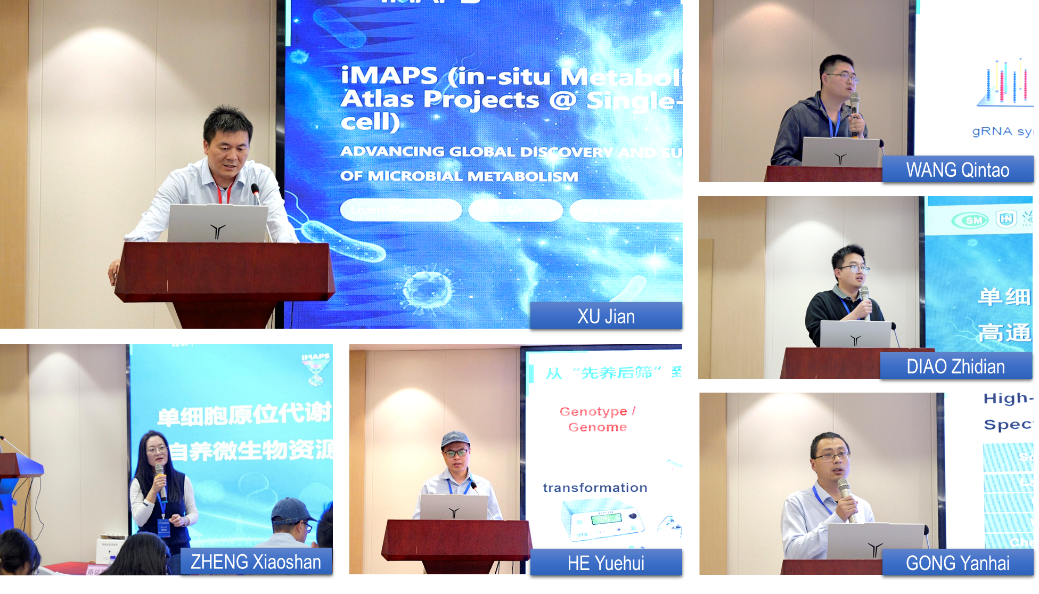
Assoc. Prof. HE Yuehui presented case studies on using algal Ramanomics to quantify intracellular products and identify metabolically active microalgal cells under different conditions. Assoc. Prof. WANG Qintao described integrated strategies that combine CRISPR/Cas genome editing with FlowRACS to efficiently select improved microbial strains. Dr. DIAO Zhidian showcased the Digital Colony Picker (DCP), a microfluidic platform with 16,000 microchambers that enables rapid, targeted retrieval of single clones for synthetic biology and microbial cultivation workflows.
To support data-intensive applications, Associate Professor Yanhai Gong presented a complete pipeline of Raman data analysis tools. RamEx software provides standardized preprocessing and quality control of Raman spectra, while RamanAI is an online, web-based platform that allows users to upload and batch process large numbers of Raman spectra, performing automated preprocessing, feature extraction, and AI-driven classification to enable high-throughput, reproducible analysis.
A dedicated discussion session, co-chaired by Prof. XU Jian and senior engineer ZHENG Xiaoshan, focused on “Challenges and opportunities of the iMAPS program in mining autotrophic microbial resources.” Participants raised practical questions on instrument operation, assay design, and phenotype readouts. The organizers used a “Q&A plus scenario-based” format to connect specific technical capabilities with real research and industrial needs, promoting precise matching between technology and applications.
The training highlighted QIBEBT’s strengths in autotrophic microbiome resource mining. Looking ahead, QIBEBT plans to leverage the iMAPS (in-situ Metabolic Atlas Projects @ Single-cell) Consortium (www.imaps.info) to further develop metaramanomics technologies, expand collaborations, and address global challenges like climate change, health, and biomanufacturing.
About iMAPS:
The iMAPS Consortium is a global collaboration aimed at establishing a network of facilities, each serving as a "metabolic sensor, functional-strain miner, and ecological remediator" for microbiomes in specific fields or regions. By integrating metaramanomics and AI-powered data systems, iMAPS enables real-time, label-free profiling and mining of metabolic activities of microbiomes across ecosystems, advancing solutions for climate change, health, and biomanufacturing.